Write-up
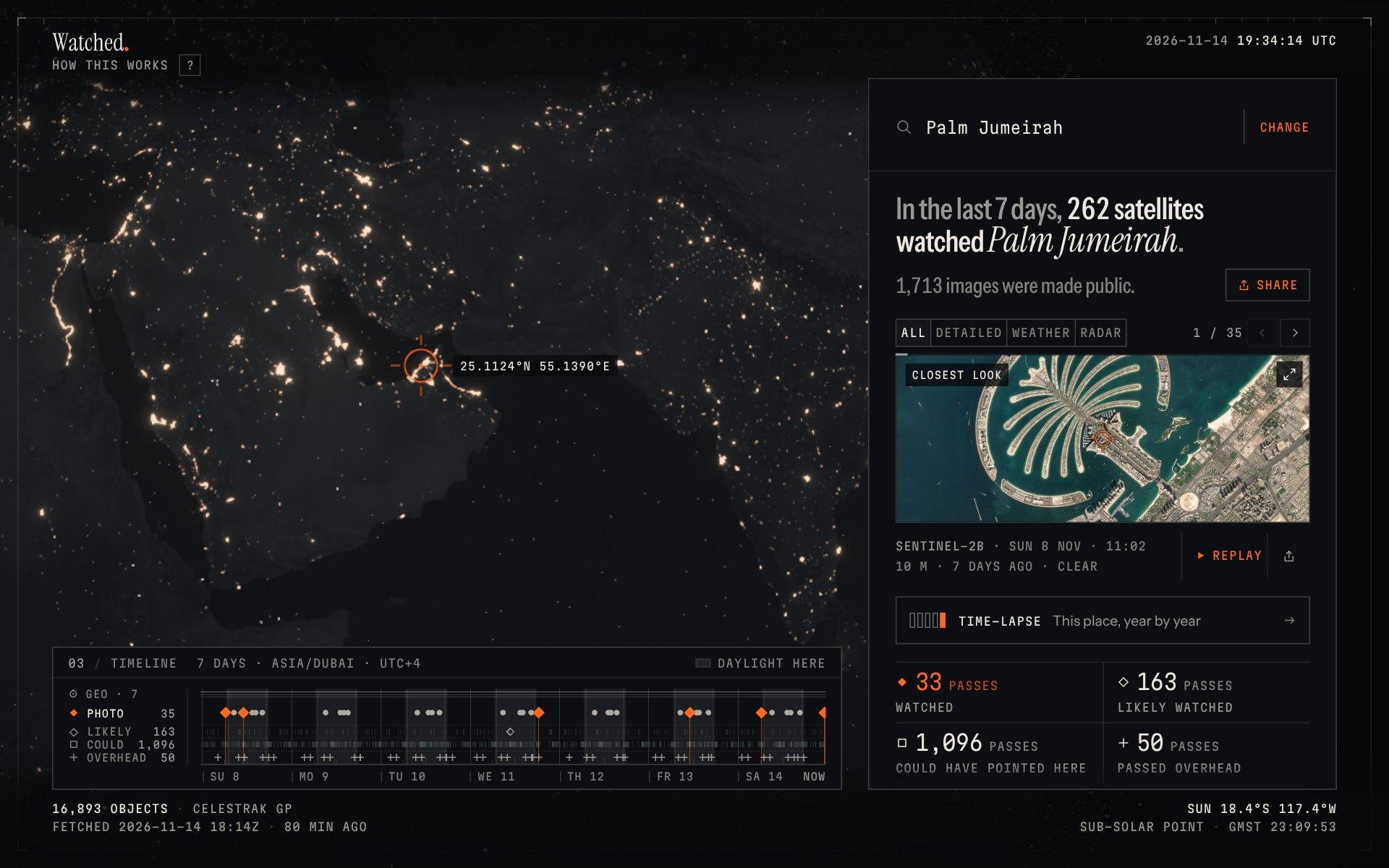
watched.earth does one thing: you give it any place on earth, and it shows you every satellite that passed over it in the last 7 days, plus the actual pictures they took. it's free, there's no sign-up, and the orbit maths runs in your browser.
i built it solo and open sourced the whole thing. it picked up 500+ points on hacker news and crossed 1,000,000 users in its first week, which is still a little hard to wrap my head around.
the hard part is not missing anything. a narrow camera sweeps past a place in a few seconds, so checking the week at fixed intervals either skips passes or takes forever. instead, the search works out the fastest a satellite could possibly be closing in on your spot and never steps further than that, so a pass can't fall between two samples. then it pins the closest approach to a tenth of a second. i ran it against a one-second brute force on the nastiest cases i could come up with (both poles, the antimeridian, null island) and it missed nothing. a full week for all ~400 satellites it tracks takes 1.3 seconds on one thread.
finding the passes is half of it. the other half is matching each one to a real photo in the public archives: sentinel-2, landsat, sentinel-1 radar, and nasa's and eumetsat's weather imagery. that's trickier than it sounds, because an archive's timestamp isn't when the satellite was over you, it's when it started recording the strip, up to 7 minutes earlier. every photo also gets cut on the same grid in the satellite's own pixels, so nothing is warped and eleven years of time-lapse frames line up with no alignment step.
the globe draws all ~17,000 active satellites at once. a vertex shader solves kepler's equation for every one of them, every frame, so the whole swarm lives on the gpu. the sun is placed to about a hundredth of a degree, which means the day/night line and the city lights are where they really are right now.
doing the heavy lifting on your device also means the backend gets to stay tiny: a handful of functions on a cloudflare worker and a locked-down supabase database that can only do four things. that's a nice property to have when a million people show up in a week. lookups are stored as 10 km cells and raw events are deleted after 48 hours, because a site about being watched probably shouldn't be watching you.
the thing i care about most is that it never overclaims. every pass gets one of four labels, and only "watched" means there's a real published image of your spot from that pass. the photos are 10 m a pixel at best, so nobody can be made out in them, and the site tells you exactly that.